Showing posts with label films. Show all posts

June 10, 2008

Bella Notte - a Valentine's song

This scene from the movie "The Lady and the Tramp" has been considered the most romantic in the history of the cinema! Watch the video, listen to the song and put the lyrics in the correct order!


___ Oh this is the night,

___ Look at the skies,

___ The night will weave its magic spell,

___ And we call it bella notte

___ And the heavens are right!

___ They have stars in their eyes

___ You'll find enchantment here.

___ Side by side with your loved one,

___ On this lovely bella notte.

___ It's a beautiful night

___ Oh this is the night,

___ When the one you love is near!

___ On this lovely bella notte!

Now check the lyrics clicking on comments!

March 20, 2008

Three biographies: Minghella, Clarke and Scofield

Three impotant British personalities have died this week: Anthony Minghella, Arthur C. Clarke and Paul Scofield. Who were they? Click on their names to read about their work and lives and then try this short matching activity.
See also:

December 29, 2007

War times are not the same

by Adriana Kakehasi

Film: The English Patient, 1996
Screenplay and direction: Anthony Minghella
With: Ralph Fiennes (Schindler's List), Juliette Binoche (Chocolate), Willem Dafoe, Kristin Scott Thomas
Soundtrack: Gabriel Yared (Betty Blue)

Based on the novel of the same title by Michael Ondaatje

At the end of the Second World War, we can say that two stories go on vividly at the same time. The first is the past of Almasy (Ralph Fiennes), an unidentified ill man living in an Italian village under the care of a strong woman. The other involves Hana (Juliette Binoche), a 20-year-old Canadian nurse, tired of the homeless life, and two other men that make part of her life in very distinct ways: Kip - a bomb disarmer and Caravaggio - a retired thief. As she reads Herodotus to the English patient, he remembers every minute until the tragic end of his only truthful romance. Even though he tries in vain to forget it, the memories come with such intense pain that neither the doses of morphine nor his actual appearance can overcome that. The main point in commom for all of them is the feeling of hopelessness in life, the result of miserable years of war.

Although the book is mainly located in a villa near Florence, where the English patient, Hana, Caravaggio (Willem Dafoe on the screen) and Kip are, Anthony Minghella`s competent adaptation was capable of a very beautiful migration from the Italian scenery to the desert and of a tremendous growth of some characters, not extensively explored by the author, Michael Ondaatje. One can say that an example of this 'upgrade' is Kristin S Thomas' work as Katherine, not to mention the perfect participation of Juliette Binoche, even looking some years older than the original Hana. Another impressive point is the photography, which brings us a gorgeous Sahara desert, a unique place for a torrid romance, and permits an appreciation of some of the ancient rules of what is considered such an inhospitable location.

The soundtrack by Gabriel Yared (Betty Blue) is another precious gift in this adaptation, giving us an extra intensity to the scenes, no matter whether they are located in the desert or in Italy.

Both the book and the movie are very good examples of excellent literature and cinema. The adaptation is so powerful that it is impossible to read the book after seeing the film without remembering the screen pictures.

Can any modern war allow the contructon of such a kind of romance? Maybe not. So it would be interesting to read this masterpeace first, and give your imagination a pleasant exercise. If not feasible, you wil be very surprised by both the novel and the film.

Watch the movie trailer

More reviews:
Rumble Fish

The da Vinci Code
The Green Mile
Timeline
Under the Tuscan Sun

December 21, 2007

Film review: The Green Mile

by Felipe Coser

FILM: The Green Mile
United States, 1999
DIRECTOR: Frank Darabont
WRITERS: Frank Darabont (screenplay), Stephen King (novel)
GENRE: Drama
RUNTIME: 188 min
CAST: Tom Hanks, David Morse, Bonnie Hunt, Michael Clarke Duncan, James Cromwell, Michael Jeter, Grahan Greene, Doug Hutchison, Sam Rockwell, Bary Pepper, Jefrey Demunn, Patricia Clarkson, Harry Dean Stanton, Dabbs Greer, Eve Brent.
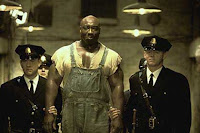

Based on a Stephen King's book, "The Green Mile" (reference to the green path linking the cells to the electric chair) is not just a story about death sentence, violence and living in prison; it's more about respectful relationships among guards and prisoners and also about a special gift (the ones we desire many people could have) carried by one of the inmates. At least that's the message we all want to keep rather than some terrible scenes of executions. Actually, Frank Darabont (director and screenwriter) had tried some of the same elements in one of his previous works ("The Shawshank Redemption"), what gave him some good background. These elements are especially those which show the good side of everyone, like humanity, honor, loyalty and friendship.

The story takes place in the death row of a certain prison in the south of the US between the end of 1920's and beginning of 1930's. The plot develops around Paul Edgecomb (Tom Hanks, Best Actor for "Philadelphia" - 1993 and "Forrest Gump" - 1994) as he leads the crew in charge of carrying out the prisoners stay on their way to execution. He's got a big handy workmate, Brutus "Brutal" Howell (David Morse, from "The Indian Runner", "12 Monkeys") who is very useful in solving troubles, mainly the ones caused by the annoying spoiled Percy Wetmore (Doug Hutchison), the governor's step-nephew. He seems more like a delinquent than a guard himself. Bary Pepper (Dean Stanton, from "Saving Private Ryan") and JeffreyDemunn (Harry Terwilliger, from "The Price) complete the team.

Paul's noble feelings, such as his dignity, became clear when treating prisoners like Eduard Delacroix (Michael Jeter, from "Patch Adams"), William "Wild Bill" Wharton (Sam Rockwell, from "Lawn Dogs"), who deserves a very good mention for his performance as a deranged man, and especially, John Coffey (Michael Clarke Duncan, from "Armagedon"), "like the drink, only not spelled the same". John is a sensitive huge black man who has this very special power of cure. He has been sentenced for the killing of two little girls.

Since the book was published in chapters the movie may seem odd to some viewers, as the film goes along three hours. Someone could wonder how come almost all the scenes were taken inside the prison (showing only the death row and its facilities) and it still got the audience's attention. The director turns this delicate characteristic (it could even compromise the whole work) into a favourable aspect of the movie by focusing on characters' feelings, on their temperament, rather than on the predictably violent scenes, for example. Paul and Coffey, particularly, have got depth. Being the chief, Paul knows exactly how to deal with the criminals, heavily or not, depending on what the situation asks for. Coffey having all those attributes (physical strength, parapsychological powers) could be just the good guy unfairly caught (only because of his skin colour), who has been still crying for his sentence, but no; he's given up, he's just tired of living. The execution scenes are mainly as disgusting as those written in the book and perhaps could have been left out.

It's worth seeing it, especially for the way Darabont conducts the movie mixing the different elements while the narrative goes. Elements such as a couple of funny scenes help to make the theme lighter than it really is. The performances of Hanks, Duncan and Rockwell help a lot to justify the time (what a time!) spent watching it.

Read also:
Book review: The Innocent Man (John Grisham)

More reviews:
Rumble Fish
The da Vinci Code
The English Patient
Timeline
Under the Tuscan Sun

December 16, 2007

Compared to the novel, Donner's Timeline is a waste of time

by Frederico Fonseca

United States, 2003

Running Length: 1:55
MPAA Classification: PG-13 (Violence)
Cast: Paul Walker, Frances O'Connor, Gerard Butler, Billy Connolly, Ethan Embry, Anna Friel, Rossif Sutherland, David Thewlis, Matt Craven, Neal McDonough
Director: Richard Donner (Ladyhawke)
Producers: Richard Donner, Lauren Shuler Donner, Jim Van Wyck
Screenplay: Jeff Maguire and George Nolfi, based on the novel by Michael Crichton (Jurassic Park, The 13th Warrior, Rising Sun)

Professor Edward Johnston (Billy Connolly), aided by his assistants Andre Marek (Gerard Butler), Chris Johnston (Paul Walker), Kate Erickson (Frances O'Connor) and François Dontelle (Rossif Sutherland), makes a huge discovery: the ruins of what was once La Roque, a 14th-century French castle. While part of his team goes down into the ruins to explore it, Professor Johnston travels to New Mexico to have a meeting with Robert Doninger, president of ITC Corp., which financially supports the excavations in France. Meanwhile, Marek and Kate discover inside the ruins a sealed chamber, and inside it, two intriguing objects - a bifocal lens, which couldn't have been invented before the chamber was sealed, and a handwritten letter from Professor Johnston dated of 1357, asking for help...From this moment on Professor's team starts a quest to rescue him from the 14th century, where he was sent by ITC's time-machine, to see with his own eyes the 100 Years War between French and English.

Although Crichton's novel is actually one of the best modern science fiction thriller books available, its adaptation to a film is a classic example of how fantastic books can turn into catastrophic films. The main reason is because it would be impossible to condense an over-500-page book into a film less than 2 hours of length and expect this film to be accurate with the original novel. The details of characters, landscape, clothes, weapons, either are not present in the film, or are carelessly inserted in it. Language differences were forgotten... so were consequences of acts made in the past. The actors, also, were not as good as they were expected to be. Billy Connolly's performance was unacceptably weak, even worse than in The Last Samurai. The same thing happened with Michael Sheen, when compared with his part in Underworld.

Regardless of his experience with previous films, such as Lethal Weapon, Ladyhawke, Superman, and at least a dozen more, director Richard Donner was unable to turn this one into a blockbuster. Maybe it was due to the low budget of the film, or simply the absence of will to do a good job, we will never know...

Except for the beautiful landscape and some special effects during the battle at La Roque, the filmmakers have not done a good job, so it would be nice if you had the opportunity to first watch it and then go to the book to get your own impressions.
More reviews:

December 12, 2007

Film review: Rumble Fish

by Saulo Saturnino

FILM: RUMBLE FISH

1982 Universal Studios.
LENGTH: 94 minutes.
Based in the novel by S.E. Hinton
SCREENPLAY: S.E. Hinton and Francis Ford Coppola.
PRODUCERS: Fred Roos and Doug Clayborne

Movies represent a particular form of art that uses images, actors' performances, soundtracks. In the environment of cinemas, they hit our brains and hearts with condensed emotions and messages transmited in few hours. Books, using reading and imagination, give us a wide-range of interpretations, and, on an individual basis, allow lots of possibilities in exploration of contents. In this way they should not be compared in terms of quality, but frequently we proceed so when novels are adapted to movies. Doing this, most of the times we tend to be disappointed with movies because, when the scope is limited, we are prone to understand this as a failure to transmit a message. Surprisingly, sometimes a movie seems much better than the book that inspired it and we start to ask how could it have happened?

Rumble Fish is a very good example of this rare situation and there is an obvious explanation: Francis Ford Coppola. Using poetry to develop a subject quite common, having an extraordinary talent to choose and explore the cast and being technically perfect he acommplishes this very difficult mission. Rusty James ( Matt Dillon ) is a teenager without any perspectives of future, who tries to build his identity based on values of street gangs. His father, an alcoholic former lawyer who was abandoned by his wife, was played majestically by Dennis Hopper. The major goal of Rusty James is to be like his brother, the Motorcycle Boy ( Mickey Rourke ), a well-educated boy that dangerously walks in the thin line between extreme intelligence and insanity and transmits all the hopelessness you imagine that could exist. Here we see clearly Francis Ford Coppolas ability to put the right piece in the right place; known as an actor with limited resources, Mickey Rourke here makes viewers wonder whether he has actually improved as an actor or if he is just being himself. His performance in Barfly, with Faye Dunaway, points to the first option.

Mixing major talents with promises of future, using technical resources like black and white and colors eventually, making metaphorical criticism to the standard social demands, Coppola shows us the limitations that we, as a society, have when accepting something that does not fit in two standard deviations above or below. Additionally, we have a funny comment about aging by Tom Waits and a young Nicholas Cage giving us the impression that Nicholas Cage will be forever Nicholas Cage regardless of the character played.If you have neither read the book or seen the movie and are look for some advice, go first to the cinema.
See also:
More reviews:

December 10, 2007

Should Frances Mayes Follow Jorge Amado's advice?

by Fernanda Watanabe

Brazilian writer Jorge Amado, the famous author of Dona Flor and Her Two Husbands, refused to watch the adaptations of his novels to the small screen because he said that his stories couldn't be recognized. Check it out if Frances Mayes should do the same about the adaptation of her book UNDER THE TUSCAN SUN to the big screen.

The book: Under the Tuscan Sun is Frances Mayes' report of her life in Italy when she and her second husband Ed decide to buy a house - Bramasole - in a small Tuscan village - Cortona. Being a creative writing professor she skillfully describes the difficulties of buying and renovating an old house in a foreign country, which are aggravated by the fact that she lives half of the year in San Francisco, US, and has to count on a group of non-professional Italian and Polish builders. But her summertime in Italy is not only about worries: she competently narrates her impressions of the country, the people and especially the local food. Her mouthwatering recipes give us the smell and the taste of Tuscany while her lyrical narrative gives us the colors of her garden and the region. Most of all she gives us the feeling and the pleasure of being under the Tuscan sun.

The film: After a traumatic divorce Frances Mayes (Diane Lane) travels to Italy to heal from the depression she sank into and in an impulse decides to buy an old house - Bramasole - in a small Tuscan village - Cortona. She has to renovate the house with the work of a group of immigrants and deal with unnattended guests and eccentric neighbours. But apparently her main purpose is to find a new love - rather than starting a new life. After some failed attempts with her real estate agent Martini (Vincent Riotta) and with a handsome stranger - Marcello (Raoul Bova), who she meets in a weekend trip to the Amalfitani cost, she eventually meets an interesting man - Ed - at a party in her new house.


Well, if you had the impression that these are two completely different stories that share the same characters' names and the same scenarios you're not far from the reality. While the book's central point is Tuscany - or Frances Mayes' impressions of Tuscany - the movie focuses on Diane Lane's character - who can't be seriously called Frances Mayes - and her search for love. It certainly wouldn't be easy to adapt a narrative lacking action and events to the big screen but everyone who read the book would be expecting something related to Babette's Feast (directed by Gabriel Axel, 1987) or a funny movie based on the exploitation of the local's idiosyncrasies. Surely it would be too optimistic to expect a movie about enjoying the delights of relaxing, gardening, cooking and eating side-by-side to a good partner.

Nevertheless, the approach chosen by the producer, director (Guinevere, 1999) and screen writer (The Truth About Cats and Dogs, 1996; Shall we Dance, 2004) Audrey Wells is fairly disappointing. Giving her background, a comic love story would be expected. She could, for instance, have made a funny film about the troubles of a freshly married couple living in an old house recently bought in Italy and yet her story would be more faithful to the original one. But creating a flirt that never happened between two real people - Mayes and Martini - or a hot weekend with a complete fictional character - Marcello - is inexplicable. First because Mayes was supposedly recovering from her depression. And also because one of the charming points of the book is the fact that her project of buying a house in Italy and part-time living there was fully supported by Ed, with whom she shared her dreams and accomplished Bramasole's renovation.

The film in itself is light and amusing entertainment and has some noticeable features: Tuscany scenery is magnificent and actually makes you feel like going over there - in fact this is the best point of the movie. Diane Lane's character isn't a stereotyped superwoman; instead, her performance is quite convincing and captivating as a vulnerable woman. Besides, Sandra Oh playing Frances' lesbian friend Patti gives us a hint of why she stood out later in TV series Grey's Anatomy. And Raoul Bova is so gorgeous that it's worth watching the movie just to see him.

The problem is that the story is totally forgettable. It gives the impression that Audrey Wells is one of these love stories writers that has a prompt formula - professionally brilliant but romantically inapt middle-aged woman tries to find Prince Charming, always falling for the wrong guys, but is finally rewarded by meeting "The One" - who only change names and places. This time it was set in Tuscany. Another problem is that it's a movie made for women - and not the feminist kind. Men won't appreciate the romantic tone and the fact that the film is about women's issues. Feminists will be upset because Frances is portrayed as someone whose happiness depends on being with a man.

And above all: why make a movie based on a book if next to nothing of the original story will be kept? Just to take advantage of its success? If the screen version doesn't make you envy Frances Mayes for spending her summers in Tuscany, in her very own great house, eating fresh tomatoes dripping olive oil, relaxing, taking her time in a lazy Mediterranean pace, it doesn't deserve to be named Under the Tuscan Sun.

So, if you still intend to watch the movie, don't read the book first. But don't forget: READ THE BOOK!

"Under the Tuscan Sun"
Written and directed by Audrey Wells, based (?) on the book by Frances Mayes.
A Touchstone Pictures release.Length: 1:53.
Frances - Diane Lane
Patti - Sandra Oh
Marcello - Raoul Bova
Martini - Vincent Riotta
See also:
More reviews:

December 09, 2007

The Da Vinci Code: Is the film more polemic than the book?

By Leticia Peixoto.


United States, 2006
Running Time: 148 Minutes
Rating: PG - 13
Director: Ron Howard
Casting: Tom Hanks (Robert Langdon); Audrey Tautou (Sophie Neveu); Ian McKellen (Sir Leigh Teabing); Alfred Molina (Bishop Aringarosa)
Screenwriter: Akiva Goldsman
Producer: Brian Grazer

Dan Brown's novel The Da Vinci Code (published in 2003) is second only to the Harry Potter series as the best-selling novel of all time, selling more than 60 millions of copies. The novel rose significant criticism about the way Dan Brown treats the Catholic Church. The story involves the secrets of a religious society hidden within the works of Leonardo Da Vinci. For some Christians it contains some negative answers. The big polemic created was due to the questioning of Jesus' divinity. Although the book says that all descriptions of arts, architecture, documents and secret rituals would be all refined, some argue that what Brown wrote is factually imprecise.

The plot of the book and also of the film is about the murder of Jacques Saunière (Jean-Pierre Marielle), custodian of the Louvre museum. Robert Langdon (Hanks), Sophie Neveu (Tatou) and Leigh Teabing (McKellen) live a series of adventures when trying to decipher the codes which answer the enigmas left by Jacques Saunière prior to his death. The history involves from traditional conservative Catholic organizations such as Opus Dei (from Latin, it means God’s work) to a secret society known as Priory of Sion, which contained numerous famous members such as Issac Newton, Botticelli, Victor Hugo and Leonardo Da Vinci.

What is really compelling about Brown's work of fiction and may be worrying Catholic and Evangelical leaders is not the book's many falsehoods. The extreme dedicated topic approached in the book created this big issue, making the film a blockbuster. Some views of Christian history were buried for centuries because leaders of the early Catholic Church wanted to present one version of Jesus' life: theirs. And the movie presents the novelist's point of view in a very soft way, without positioning itself clearly.

Film director Ron Howard has come a long way to reside in the heady company of Hollywood's most elite directors. His first Academy Award for film director was in 2001 with “A Beautiful Mind”. The great revenue generated by The Da Vinci Code film has already promoted a possible sequel story: another film version based on the novel “Angels and Demons”, also by Dan Brown with Robert Langdon playing his first adventures, might be coming up.

As it is often the case, the book was far superior, especially when the book is a bestseller and an enormous expectation has risen around it. The main reason, according to some critics, is sheer mathematics. Hollywood doesn't accept scripts over 100 pages, because each page is a minute of filming. So, what about a book over 300 pages long? As a consequence, it lost some important aspects of the book, such as the sensation of adventure and the romantic atmosphere between Robert Langdon and Sophie Neveu.

Tom Hanks (Robert Langdon) with his no sense hair seems to be distant from his character. Paul Bettany is almost unrecognizable and plays the menacing single minded Silas to utter perfection. Sir Ian McKellan was fantastic and really steals most scenes he appears in. He delivers a real character actor when playing. Audrey Tautou is as expected: warm.

Overall, it was a thoroughly enjoyable, occasionally slow moving thriller. For those who read the book, an opportunity to delight with the Louvre and a lot of scene details. For the others, the film is a great opportunity to challenge the audience's beliefs and creeds.

Nominations
Best Score - Hans Zimmer - 2006
Broadcast Film Critics AssociationBest Original Score - Hans Zimmer - 2006 Satellite AwardsBest Visual Effects - Kevin Ahern - 2006
Satellite AwardsBest Sound - Chic Ciccolini III - 2006
Satellite AwardsBest Art Direction - Contemporary Film - Allan Cameron - 2006 Art Directors Guild
Read more:
More reviews:

November 19, 2007

Women in film

This is a very interesting video showing some of the most famous film stars in the history of film making, from the early days with Mary Pickford to present time with Halle Berry. How many actresses do you recognize? Click on 'comments' to get the complete list!


If you liked it, take a look at a similar 'exercise' using face morph animation, this time dedicated to women in art.


Read also
How the studios made stars

July 10, 2007

John Travolta: much more than a woman!

You've seen him hit the dance floor in Stayin' Alive, get in trouble with Samuel L. Jackson in Pulp Fiction and play the bad guy in Swordfish. Now, could you picture John Travolta as... a woman? But that's exactly the role he is playing in the film Hairspray, a musical which opens July 20th in the U.S. (and 28 September in Brazil). Unlike some other famous actors, who have played men dressed as women, Travolta will be seen on screen as a real woman - Edna Turnblad - the mother of a teenage girl who is obsessed with a TV show. What made him do it? Read and listen to this interview and find out!

May 06, 2007

What you learn watching the film "300"

People sometimes discuss crazy things in online message boards. Going through imdb.com the other day, I came across a funny thread where movie fans talked about Zack Snyder's hit, "300". It's called "300 things I've learned watching 300". Here are 10 things people say they've discovered (my selection):


10- Phalanx: a formation where Spartans hold their shields & spears to protect themselves, kill around 3 Persians and then go off and fight however the hell way they want to fight.
9- It is completely possible to stack a 40-foot-high wall of rotting corpses in a four-hour time span without the use of heavy machinery. And dead Persians make EXCELLENT mortar for stone walls.
8- Blood disappears soon after it's exposed to oxygen.
7- Spartans were terrible at counting: 300 Spartans + 700 Thespians + 1,000 helots = 300 Spartans.
6- Rejected Spartan newborn babies skulls will mysteriously grow to full-size, adult skulls when thrown from a cliff after birth.
5- If you overfeed a rhino, it can grow twice as big as a man.
4- Ninjas were employed by the Persian army.
3- No matter what question a Spartan Captain asks his troops, "OH-WOOOOOH" is considered a completely acceptable answer.
2- The Spartan army brings a CD player with loud rock music to any war.
And...
1- Spartan shields are made from the same metal as Wonder Woman's bracelets.
Read also: